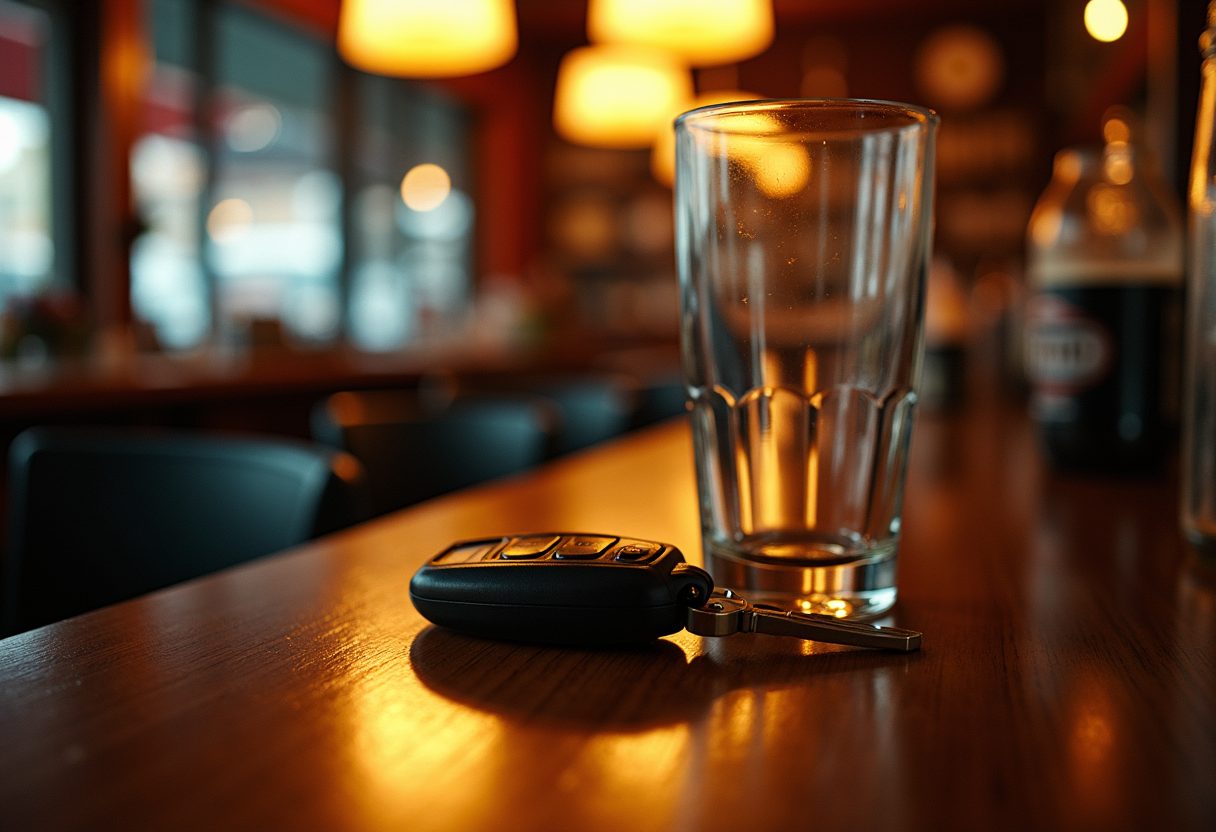
Two beers, one glass of wine too many, or something that "wore off long ago". And then blue lights in the rear-view mirror. At that moment most people are not thinking about sections of the law, but about how to get the children to school tomorrow and how to explain to the boss that the company car will be off the road for a while.
For many people a driving licence is a tool of their trade. That is why it pays to deal with this at once, not when the decision arrives in an envelope.
Misdemeanour or criminal offence
What decides is whether the driver was in a "state precluding fitness to drive". The Supreme Court holds the line at one per mille: from that level the driver is always in such a state, regardless of how they felt. Below one per mille it is generally a misdemeanour, but not automatically; the court examines how impaired the driver actually was. The criminal offence of endangerment under the influence of an addictive substance carries up to one year in prison, a fine and a driving ban. With drugs it is more complicated, because what matters is the specific substance, its level in the blood and how the test was carried out. More complicated for the police means more interesting for the defence.
What to watch out for
- Refusing the test does not help. It is punished about as severely as a positive result. Heroics do not pay here.
- Do not volunteer explanations. "I only had two" is a sentence that reads completely differently in the record than in a car park.
- Watch the deadlines. If a penal order arrives, there are 8 days for an objection. Not working days.
What can be done about it
Go through how the measurement and the sample were taken, whether the procedure was correct and what follows from that. Then choose the most sensible route: sometimes a defence, sometimes a plea agreement or conditional discontinuation. The aim is to come out of it with the smallest possible scar. And ideally with your driving licence.
What this rests on
No advice on this page is an opinion. Each one has a section of the law and a court decision behind it. Click through, the full text is on Europaius.
Statute
- § 274 tr. zákoníkuendangerment under the influence of an addictive substance: up to one year, a fine, a ban on activity
- § 73 tr. zákoníkuban on activity (driving) for one to ten years
Case law
- 7 Tdo 242/2018 (Nejvyšší soud, 15. 3. 2018)from a level of 1 per mille the driver is always in a state precluding fitness to drive
- 5 Tdo 874/2007 (Nejvyšší soud, 22. 8. 2007)a level below 1 per mille does not in itself mean fitness; the court must examine actual impairment
- III. ÚS 4209/16 (Ústavní soud, 24. 1. 2017)the driver submitted an expert report with a range of 0.84 to 1.22 per mille; the Constitutional Court dismissed the complaint, the conviction stood
Related cases
- 1,80 promile za volantem. Byla to soudkyně. 2023 (in Czech)
- Znalec připustil 0,84 až 1,22 promile. Nestačilo to. 2017 (in Czech)
Related articles
A different situation?
- You or someone close to you has been detained
- Pre-trial detention is looming, or someone is already in it
- A police summons has arrived
- Criminal complaint: you want to file one, or one has been filed against you
- You have been charged with a criminal offence
- A penal order has arrived
- Plea agreement, conditional discontinuation
- House search
- You have become the victim of a crime
- European arrest warrant, extradition abroad
- Charged with embezzlement
- Disorderly conduct: a brawl, a pub, the street
- Dangerous threats and stalking
- You drove while banned from driving
- Charged with bodily harm
- Damage to property
- Violation of the inviolability of the home
- Defamation
- Conditional release from prison
- Negligent homicide: a fatal accident
- Credit fraud and subsidy fraud